Quick answer: Bring your watch in for service if it gains or loses more than 30 seconds a day, the seconds hand jumps irregularly, the crown feels gritty, you see moisture under the crystal, it stops and restarts on its own, it has not been serviced in five-plus years, or the crystal is scratched or cracked. Catching any one of these early often means a simple service instead of a movement rebuild.
Why Watch Service Gets Ignored (Until It's Too Late)
Watches are often treated like appliances — expected to keep running indefinitely with minimal attention. But mechanical and automatic watches are precision machines with dozens of moving parts, each requiring proper lubrication, alignment, and occasional adjustment. Even quartz watches have components that degrade over time.
The result of neglect is predictable: a watch that runs poorly, stops unexpectedly, or suffers internal damage that could have been prevented with timely service. Recognizing the warning signs early saves money and protects your timepiece.
Sign 1: Gaining or Losing More Than 30 Seconds Per Day
All mechanical watches have some rate variance — even fine Swiss movements gain or lose a few seconds daily. But if your watch is consistently off by 30 seconds or more per day, the movement needs attention.
Common causes include worn mainspring, dried-out lubricants causing increased friction, or a balance wheel that needs regulation. A watchmaker can diagnose and correct rate issues in most cases, often during a standard service.
Sign 2: The Seconds Hand Jumps in Irregular Intervals
A healthy mechanical seconds hand sweeps smoothly (or ticks consistently for lower beat movements). If it starts jumping in irregular intervals — say 2 seconds at a time, then 1, then 3 — this is a sign of a mainspring issue or a problem with the escapement.
For quartz watches, a seconds hand that jumps every 2–5 seconds (instead of every 1 second) almost always means the battery is dying. Replace it promptly — a dead battery left in a watch can leak and corrode the movement.
Sign 3: The Crown Is Difficult to Turn or Feels Gritty
The crown (the winding knob on the side) should turn smoothly whether you are winding the watch, setting the date, or setting the time. Resistance, grinding sensations, or a crown that spins freely without engaging are all signs of internal wear.
Forcing a stiff crown risks damaging the stem and crown mechanism — a repair that is more involved than the underlying issue that caused the stiffness. If it feels off, stop forcing it and have a watchmaker look at it.
Sign 4: Visible Moisture or Condensation Under the Crystal
Water resistance degrades over time as gaskets dry, crack, and compress. If you see fogging, condensation, or water droplets inside your watch crystal, moisture has already entered the case.
This is urgent. Moisture causes rapid corrosion of the movement, dial, and hands. Bring the watch in immediately — the faster you act, the less damage occurs. Do not try to "dry it out" at home by leaving it in rice; that folk remedy does not remove moisture from a sealed watch case.
Our Georgetown shop offers water resistance pressure testing. It is a quick, inexpensive test that tells you whether your watch is still sealed before you take it swimming.
Sign 5: The Watch Stops Then Restarts on Its Own
A watch that stops and restarts without being wound (for mechanical) or with a fresh battery (for quartz) has an intermittent fault. On mechanical watches, this often points to a magnetized movement — watches exposed to magnetic fields from phone speakers, bag clasps, or electronics can become magnetized, causing erratic timekeeping or stopping.
Demagnetizing is a quick, inexpensive fix at a watch service center. Left untreated, a magnetized movement causes accelerated wear.
Sign 6: It Has Not Been Serviced in 5+ Years
Even a watch that appears to be running fine needs periodic service. Lubricants dry out over time, turning from protective oils into sludge that increases friction and accelerates wear. The recommended service interval for most mechanical and automatic watches is every 3–5 years.
Think of it like an oil change for a car — not something you do because the car is broken, but because the oil degrades whether or not you notice symptoms.
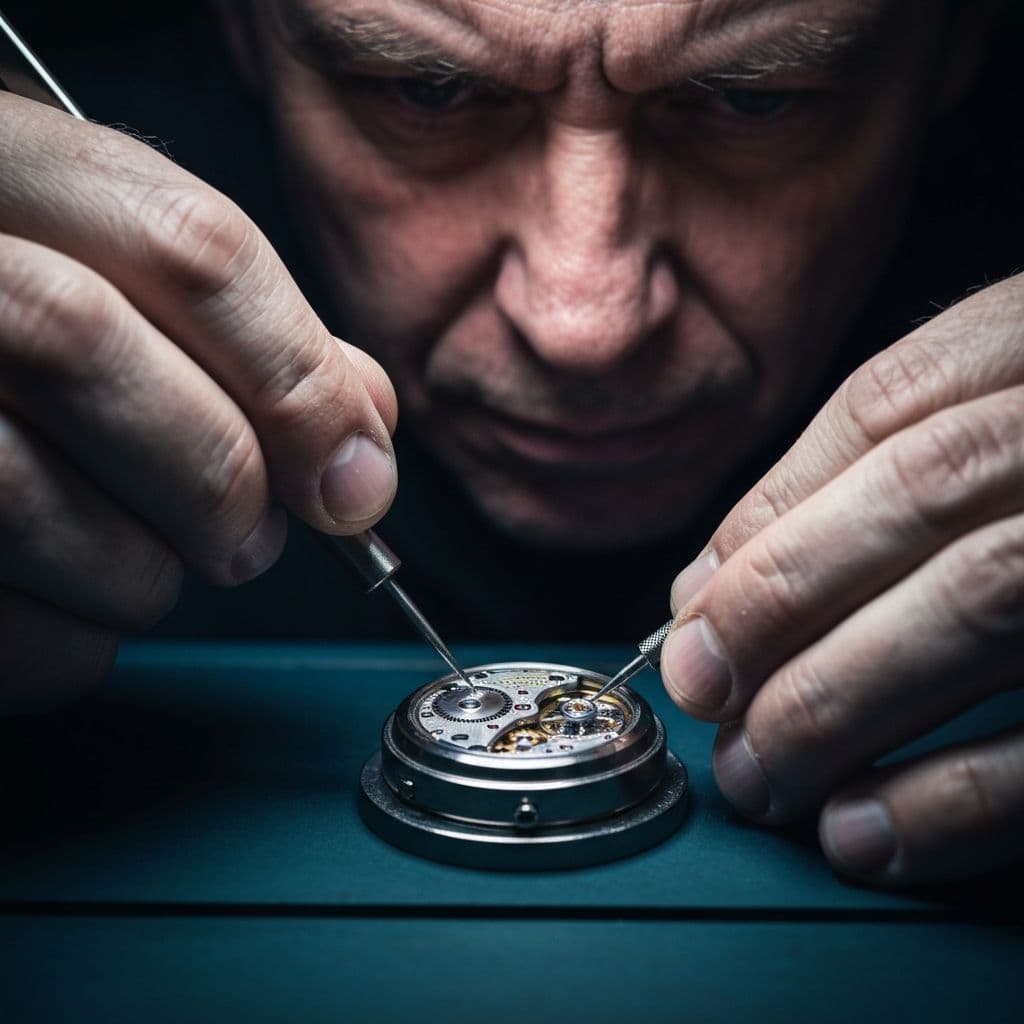
A full service involves disassembly, ultrasonic cleaning of all components, fresh lubrication, reassembly, and regulation. It restores factory performance and adds years to the movement's life.
Sign 7: A Scratched or Cracked Crystal
A scratched crystal does not just look bad — it can compromise water resistance in watches where the crystal is part of the case seal. A cracked crystal is a direct entry point for moisture and dust.
Crystal replacement is one of the simpler watch repairs. We keep common mineral glass crystals in stock and can often complete the replacement while you wait. Sapphire crystal replacements take a few days but result in a scratch-resistant surface that outlasts the original in most cases.